

 by
by 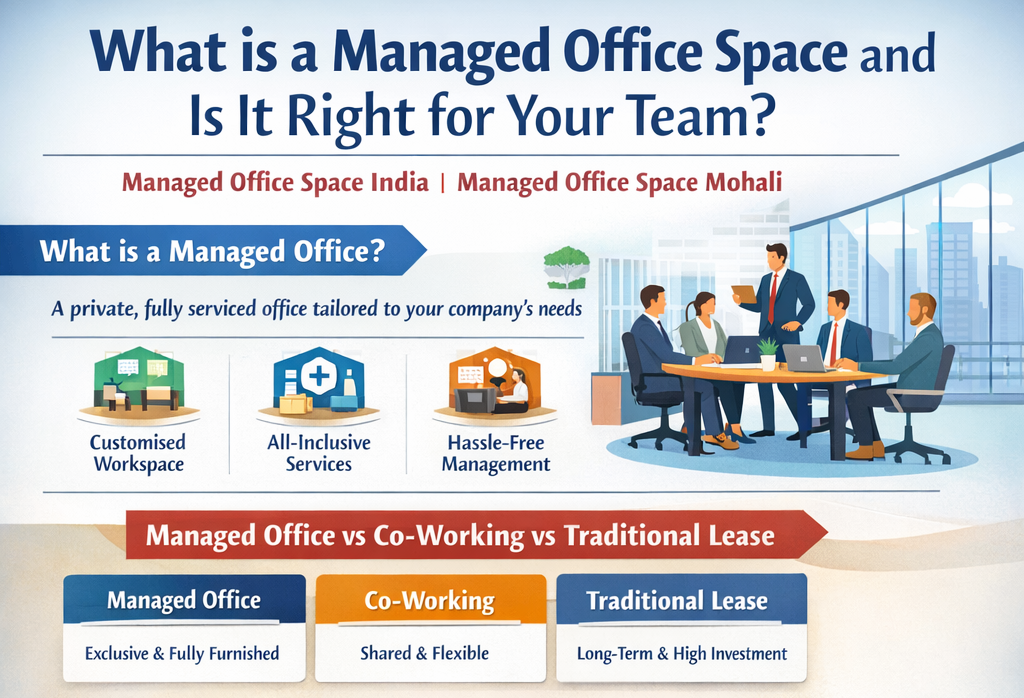
Managed Office Space
A managed office space is a fully operational workspace that a real estate operator fits out, furnishes, and manages on behalf of a specific company. Unlike co-working spaces — where you share the floor with other businesses — a managed office gives your company exclusive use of the entire space.
Think of it this way: the operator builds the office to your specifications, takes care of all the day-to-day facility management (housekeeping, security, IT infrastructure, utilities), and charges you a single monthly fee. You walk in, your team sits down, and work begins.
The lease is typically structured as an “operator agreement” or “service agreement” rather than a traditional lease, which means significantly less capex on your end and faster occupancy timelines.
Managed Office Space vs Co-working Space vs Traditional Lease
| Managed Office | Co-working | Traditional Lease | |
|---|---|---|---|
| Exclusivity | Your company only | Shared floor | Your company only |
| Fit-out cost | Zero (operator bears it) | Zero | High (tenant bears it) |
| Lock-in period | 12–36 months typically | Month-to-month or 6 months | 36–60 months typically |
| Monthly cost | Higher per SFT, but all-in | Variable (per seat) | Lower per SFT, but add-ons high |
| Customisation | Moderate | Low | High |
| Move-in time | 2–4 weeks | Immediate | 3–6 months |
| Best for | 25–500 person teams | Freelancers, small teams | Established companies, 5+ year horizon |

The Key Benefits of a Managed Office Space
1. Zero capital expenditure on fit-out
Setting up a raw or warm shell office typically costs ₹800–₹2,500 per SFT depending on the quality of fit-out. For a 10,000 SFT space, that’s ₹80 lakh to ₹2.5 crore out of pocket before your team even sits down. In a managed office, the operator absorbs this cost and amortises it into your monthly fee.
2. Predictable, all-inclusive pricing
One monthly invoice covers rent, maintenance, housekeeping, security, internet, and common area costs. No surprise repair bills, no utility negotiations, no building management headaches.
3. Speed to market
For GCCs and multinational companies entering the Indian market, time is critical. A managed office can be operational in 2–6 weeks compared to 3–6 months for a traditional leased and fitted-out space.
4. Flexibility as you scale
Most managed office operators allow for space expansion within the same building or cluster, meaning you’re not locked into a fixed footprint for years. As your India team grows from 50 to 150 people, your space can grow with them.
5. Professional facility management
A dedicated facility manager handles everything from maintenance requests to visitor management. For companies building their first India office, this removes significant operational complexity.
When a Managed Office Makes the Most Sense
Managed offices aren’t for everyone. Here’s when they’re the clearest choice:
You’re a GCC or MNC setting up in India for the first time. You want a professional, branded workspace without the complexity of managing a lease, fit-out, and facility team in a new market. A managed office lets you focus on hiring and operations.
Your team is between 25 and 300 people. Below 25, co-working is typically more flexible and cost-effective. Above 300, the economics of a traditional lease usually make more sense.
You need to be operational within 60 days. Traditional leased offices simply cannot be set up that fast. If speed matters, managed office space is the answer.
You’re in a growth phase with uncertain headcount. If you’re not sure whether you’ll be 80 or 150 people in 18 months, the flexibility of a managed office protects you from over-committing or under-provisioning space.
When a Traditional Lease Still Makes Sense
If your headcount is stable and you have a clear 5–7 year horizon in a city, a traditional lease will typically cost 20–35% less per SFT than a managed office over the same period. The upfront fit-out investment pays back over time through lower monthly outgoings.
Companies with strong brand identity and specific workplace design requirements — where the office itself is a recruitment and culture tool — often prefer the control of a traditional lease.
Managed Offices in Mohali, Chandigarh & Noida
The managed office concept is growing strongly in Tier-2 Indian cities, where multinational companies are finding high-quality managed options at a fraction of the cost of equivalent spaces in Bengaluru or Mumbai.
In Mohali and Chandigarh, several Grade-A buildings now offer managed workspace at ₹55–₹90 per SFT per month all-inclusive — a compelling proposition for GCCs and IT companies.
Fyndaspace has verified managed office listings across Mohali, Noida, and Chandigarh. Our advisors can walk you through operator terms, benchmark pricing, and negotiate on your behalf.
Browse managed office listings → Share your managed office requirement →
The Bottom Line
A managed office is the fastest, lowest-risk way to get your team into a high-quality, branded workspace in India. The all-in pricing and operational simplicity come at a premium over raw leased space — but for most companies at the right stage of growth, that premium is well worth paying.
The key questions to ask any managed office operator: What’s included in the monthly fee? What are the exit clauses? What’s the SLA for maintenance and IT? And can you expand within the building if you need to?
Fyndaspace’s advisors can help you compare managed office options against traditional leases for your specific requirement — with full cost modelling across a 3–5 year horizon.
Also read:
- Top 5 IT Parks in Mohali for Office Space in 2025
- Office Space for Rent in Mohali — Browse All Listings
- GCC Setup Guide: How to Find Office Space in India’s Tier-2 Cities (coming soon)
Fyndaspace.com is India’s trusted office space marketplace. 550+ transactions closed. 350+ happy clients. Call us at +91-91155-51199.
Join The Discussion